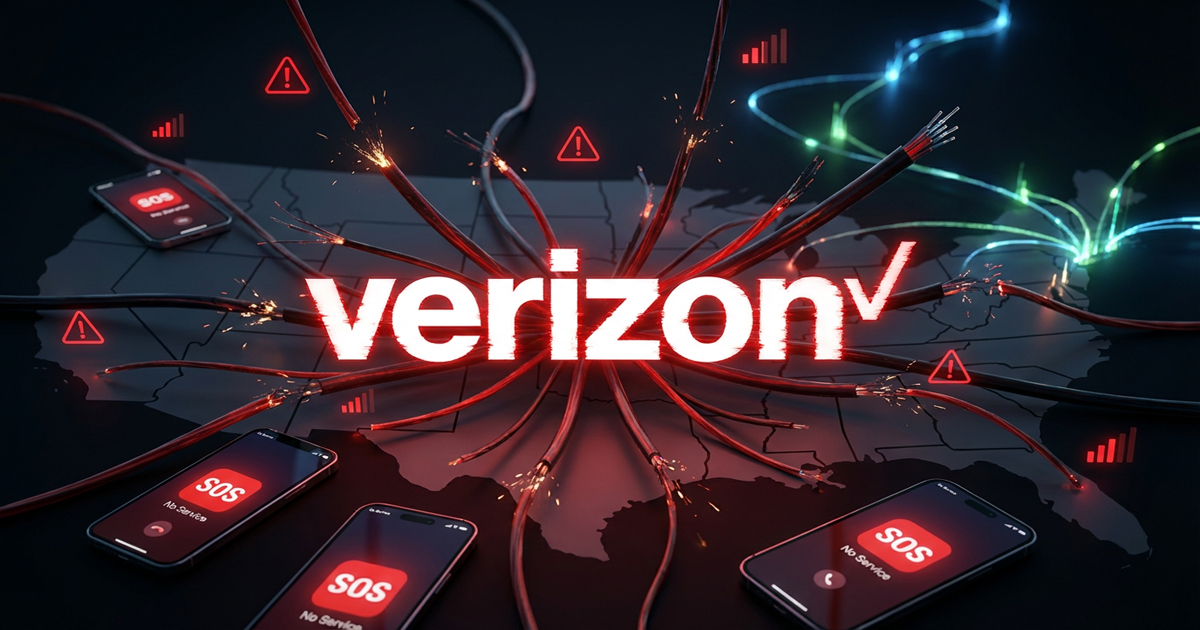
A widespread Verizon network outage has disrupted cellular service for customers across the United States, leaving many iPhone users with the SOS indicator in their status bars. The carrier confirmed the service interruption affecting wireless voice and data, with reports suggesting the issue may also be impacting cross-network communication for AT&T and T-Mobile subscribers attempting to reach Verizon customers.
Understanding the Outage Scope
According to service monitoring platforms, the outage began around midday Eastern Time and quickly spread nationwide, affecting users on both coasts. Verizon subscribers have reported complete loss of cellular connectivity, with many iPhone users seeing the distinctive SOS indicator where their signal bars normally appear.
The outage appears to be primarily centered on Verizon’s network infrastructure, though AT&T and T-Mobile customers have reported difficulty connecting with Verizon subscribers. Evidence suggests these are secondary effects rather than independent outages on competing networks.
What the SOS Indicator Means for iPhone Users
When an iPhone displays SOS or SOS Only in the status bar, it indicates the device cannot connect to its carrier’s cellular network. According to Apple’s documentation, this mode still allows emergency calls to be placed through any available carrier network, ensuring users can reach emergency services even without their primary connection.
iPhone users experiencing this issue should understand that the problem lies with carrier infrastructure rather than their devices. The SOS indicator is functioning as designed, alerting users to the network unavailability while maintaining emergency calling capabilities.
Verizon’s Response and Timeline
Verizon acknowledged the service disruption through official channels, stating that engineering teams are “fully deployed and are focused on the issue.” The carrier has emphasized its understanding of the impact on customer connectivity and has committed to resolving the problem as quickly as possible.
In subsequent updates, Verizon confirmed that teams continue addressing the service interruptions, though the carrier has not provided specific details about the root cause or an estimated restoration timeline. The lack of technical specifics is typical for carriers during active outage investigations.
Cross-Network Impact
T-Mobile issued a statement clarifying that its network is operating optimally but acknowledged that customers may experience difficulty reaching Verizon subscribers due to the reported outage. This suggests the issue is creating ripple effects across carrier interconnections, even as competing networks maintain their own infrastructure stability.
The situation highlights the complexity of modern cellular networks, where outages on one carrier can create secondary communication issues across the broader telecommunications ecosystem. AT&T has not issued an official statement regarding any impact on its services.
What iPhone Users Should Do
During carrier outages of this nature, iPhone users have limited options beyond waiting for service restoration. However, several steps can help manage connectivity during the interruption:
- Connect to available Wi-Fi networks to maintain internet access and use services like iMessage and FaceTime
- Avoid repeatedly toggling Airplane Mode or restarting devices, as this is unlikely to resolve carrier-level infrastructure issues
- Check carrier status pages and social media channels for official updates
- Remember that emergency calls remain available even when SOS is displayed
- Consider using Wi-Fi calling if previously enabled in iPhone settings
Historical Context and Carrier Reliability
Major carrier outages, while relatively rare, periodically affect all major U.S. telecommunications providers. These events typically result from complex infrastructure failures, software updates gone wrong, or configuration errors rather than cybersecurity incidents. Verizon has generally maintained a reputation for network reliability, making widespread outages like this particularly notable.
The wireless industry’s increasing complexity, with 5G infrastructure deployment and evolving network technologies, creates new potential points of failure even as carriers invest heavily in redundancy and reliability measures.
FAQ
Q: Can I still make emergency calls when my iPhone shows SOS?
A: Yes, the SOS indicator specifically means your iPhone can still place emergency calls through any available carrier network, even though your primary carrier connection is unavailable.
Q: Will restarting my iPhone fix the SOS problem during a carrier outage?
A: No, restarting your device will not resolve issues caused by carrier infrastructure problems. The SOS indicator reflects network unavailability beyond your device’s control.
Q: How can I stay connected during a Verizon outage?
A: Connect to Wi-Fi networks to maintain internet access and use Wi-Fi calling if enabled. Services like iMessage, FaceTime, and other internet-based communication apps will continue functioning over Wi-Fi connections.
MacReview Verdict
The nationwide Verizon outage serves as a reminder of our dependence on carrier infrastructure and the vulnerabilities inherent in complex telecommunications systems. iPhone users affected by the outage can take comfort in knowing their devices are functioning properly, with the SOS indicator working exactly as Apple designed it to maintain emergency calling capabilities.
While Verizon has confirmed awareness of the issue and deployed engineering resources, the lack of specific timeline information leaves customers in a holding pattern. The carrier’s track record suggests restoration efforts are being prioritized, though the scope of the outage indicates a significant infrastructure challenge requiring careful remediation to prevent recurring issues.
For iPhone users, this situation underscores the importance of having Wi-Fi calling configured and knowing alternative communication methods when primary cellular service becomes unavailable. As networks grow more complex with 5G expansion and evolving technologies, understanding how your iPhone handles connectivity disruptions becomes increasingly valuable.