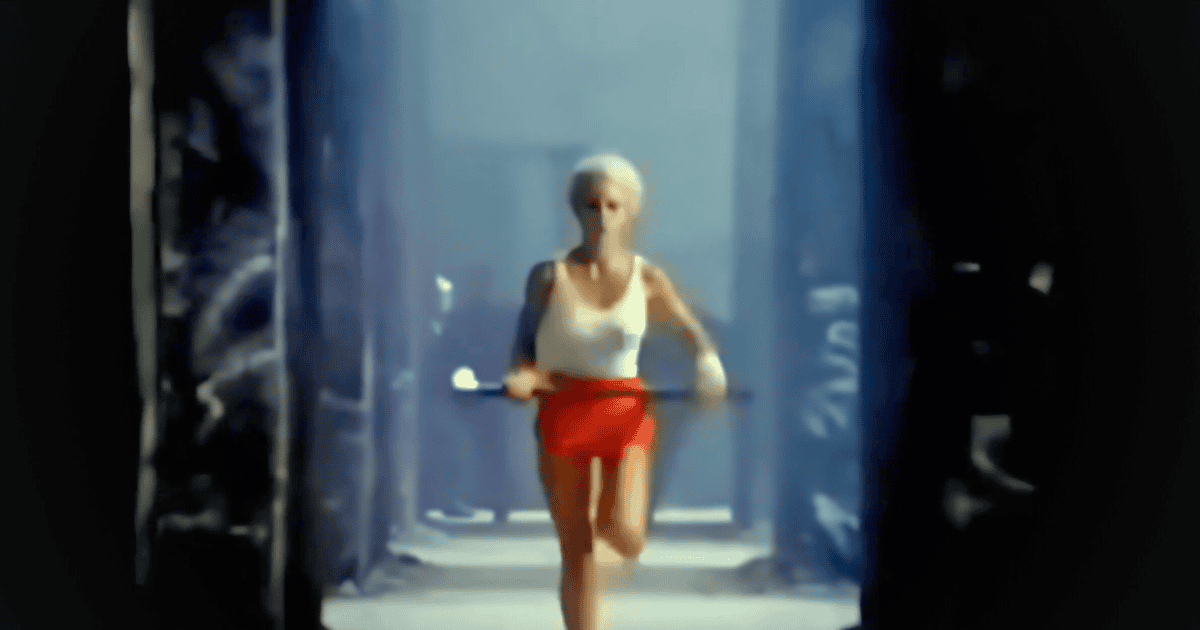
Apple’s “1984” commercial ran once on American national television, in the third quarter of Super Bowl XVIII on CBS on 22 January 1984. Ridley Scott directed it for Chiat/Day. It never mentions the Macintosh, never shows a computer, and ends on one line of text. Two days later Steve Jobs pulled the machine out of a bag on stage.
Key Takeaways
- Ridley Scott directed it in England, two years after Blade Runner. Athlete Anya Major plays the runner, actor David Graham the face on the screen.
- The tagline “Why 1984 won’t be like 1984” was written by Chiat/Day’s Steve Hayden and Brent Thomas in 1982 and rejected by several clients before Jobs took it.
- Reported production costs range from under $250,000 to $900,000 depending on who is telling it. Scott gives the lowest figure and he was there.
- The single national airing is close to true but not literally true. It ran on a small Idaho station in December 1983 to qualify for awards, then in cinemas from 17 January 1984.
- The “Apple’s board hated it” story is real in outline and unreliable in detail. Almost all of it traces to John Sculley’s memoir and to agency people recalling it later.
What the Ad Actually Shows
Gray figures with shaved heads file through a tunnel into a hall and sit in rows before an enormous screen. A man’s face fills it, lecturing them. A woman in bright athletic clothing runs down the aisle with a sledgehammer, pursued by riot police. She spins, throws, and the screen detonates. A line of text promises the coming year will not resemble the one in the book.
Sixty seconds. No product, no price, no specification. In 1983, when computer advertising was a man in a tie beside a beige box listing its memory, this was barely legible as an act of commerce. Calling it a great ad misses the point slightly. It is more accurate to call it a great refusal.
Who Made It, and Why Ridley Scott
Chiat/Day of Venice, California held the Apple account. Steve Hayden wrote it, Brent Thomas art directed, Lee Clow ran the creative side. The line came first: Hayden and Thomas had “Why 1984 won’t be like 1984” in a drawer since 1982, pitched around and turned down repeatedly, including once to Apple for the Apple II. Jobs took it in 1983.
Scott was hired for exactly what you would expect. Alien and Blade Runner had made him the director you called if you wanted an oppressive future to look lived-in rather than staged. He shot in England on a tight budget, cast real skinheads as the workers, and gave the lead to Anya Major partly because she was a discus thrower.
Scott has said the whole thing cost under $250,000. The New York Times reported around $370,000. Academic accounts have repeated $900,000 for decades. These cannot all be right, and the highest figure is the one most often quoted, which tells you how the story has traveled.
Did Apple’s Board Really Try to Kill It?
Something close to it happened, but the version you have read is tidier than the evidence. Here is the documented version against the legend.
| The familiar claim | What the record actually supports |
|---|---|
| The board unanimously hated it | Sculley wrote in his memoir Odyssey that “not a single outside board member liked it”. One participant’s recollection of a private meeting, years later. No minutes exist. |
| A director wanted the agency fired | Attributed to Mike Markkula, through the same secondhand chain. He has not, so far as the public record shows, said it himself. |
| Jobs fought the board to save it | The documented resistance came from the agency. Sculley told Chiat/Day to sell the airtime; Jay Chiat sold the 30-second slot and said the 60-second could not be shifted. Accounts agree he did not try hard. |
| Wozniak offered to pay for it himself | Wozniak tells this one directly: he asked Jobs the cost, heard $800,000, offered to split it. He also notes the money was never needed, the part usually left out. |
| Everyone knew it would work | The opposite. Fred Goldberg, the agency’s account man, said it tested as “the worst business commercial that they’ve ever tested” in a decade, scoring 5 against a norm of 29, and that he filed the results and never sent them to Apple. |
Goldberg gave the clearest account of the board’s worry, and it was not aesthetics. “Here we are, slapping the industry leader in the face,” he recalled them thinking. Apple in late 1983 had one successful product line and a failed Lisa. Nervous directors were not being stupid.
What nobody can now establish is the temperature of the room. Sculley wrote with a reputation to manage, while other participants were still contesting that period’s history. Treat it as evidence, not transcript. The board was hostile, the CEO wavered, the agency slow-walked its instructions, and the ad ran.
Why Did It Air Nationally Only Once?
Because Apple only ever bought one national slot. No second buy, no repeat in February. The ad had done its job on the night, and the next day’s news coverage handed Apple a second and larger audience for nothing.
The line still needs two qualifications. First, it had already been broadcast in late December 1983 on a handful of small American stations, most famously KMVT in Twin Falls, Idaho, timed to fall inside the calendar year so it would qualify for the 1984 advertising awards. It worked: the spot took a Clio and the Grand Prix at Cannes. Accounts of that airing conflict on both date and hour, giving variously 15 December, 1am on 31 December, and the last slot before midnight. A good illustration of how loose the record is.
Second, Apple bought months of cinema screen time through ScreenVision and the spot ran before films from 17 January 1984, with some theater owners reportedly keeping it on after the contract lapsed. So it aired once in American national prime time. It was not seen once. Apple has revisited it only in 2004, in an anniversary edit with an iPod added to the runner, released online rather than bought as airtime.
Who Big Brother Was Meant to Be
IBM, and everyone in the industry understood that without Apple saying it. IBM entered personal computing in 1981 and by 1983 set the standard others copied. The ad put that fight on television without naming names, which is why it plays as drama rather than attack.
The borrowing was direct enough that George Orwell’s estate sent Apple and Chiat/Day a cease-and-desist letter claiming copyright infringement. The ad had already run and was not running again, so nothing came of it. The allusion was not subtle and was never meant to be.
It has aged awkwardly, and an honest look should say so. A trillion-dollar company that controls which software you may install on hardware you own is a peculiar heir to a spot about smashing centralized authority. Regulators, developers and rivals have made that point for twenty years. The ad did not predict it. It was made by a company being outsold by the one it mocked.
What It Established About Apple’s Marketing
Above all, that Apple sells identity before specification. The ad carries no product information at all. Every Apple campaign since that has worked, from Think Different to the silhouette iPod posters, followed that rule. The flops are where somebody started listing features.
It also turned the Super Bowl into an event where the advertising is content rather than interruption. Before 1984 the game was expensive airtime. Afterwards brands made spots built to be discussed the next morning, and networks sold them as part of the show.
And it set the shape of an Apple launch: a scheduled cultural moment, not a press release. Ad on the Sunday, machine on the Tuesday, sequencing deliberate. Tease first, reveal second. That choreography is now so standard across the industry it is hard to see as an invention.
Frequently Asked Questions
How much did Apple pay to air the 1984 commercial?
Nobody has published an invoice. Chiat/Day booked a 60-second slot in the third quarter and a 30-second slot later, and reported costs run from the $800,000 Wozniak recalls Jobs quoting him to over $1 million for the pair. The 30-second slot was sold off, so Apple paid for one.
Did the 1984 ad actually sell Macintoshes?
In the short term, yes. Apple reported strong sales across the hundred day campaign the ad opened. The longer picture is less flattering. The original Macintosh had 128 KB of memory, no hard disk and little software, and sales slumped through the back half of 1984.
MacReview Verdict
As film it holds up completely, which little television from 1984 manages. As history it is the most over-told story in Apple’s archive, and the retelling has quietly hardened a set of anecdotes into facts they were never strong enough to become.
The safe summary is short. Scott directed it, Chiat/Day made it, Apple’s board did not want it, the agency ran it anyway, and it aired nationally exactly once. Everything past that, the budget, the December date, who said what in the boardroom, rests on memoirs rather than documents. That does not make it false. It does mean anyone stating those details flatly, without a source, is repeating rather than reporting.
Its most durable legacy is its least discussed. The ad taught an industry that you can spend a fortune saying nothing about your product and win. Most who copied it have proved they should not have tried.