
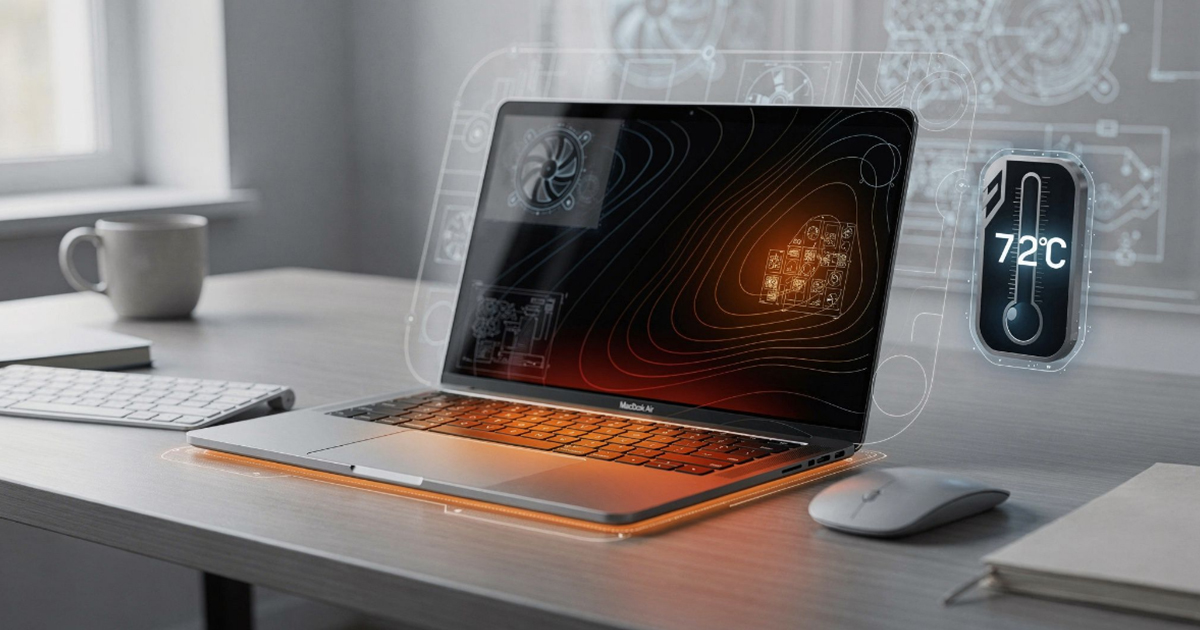
The upcoming M5 MacBook Air is expected to deliver a straightforward specification upgrade, but the device’s thermal management has remained unchanged since its 2022 redesign. As Apple continues improving cooling systems across its iPad and iPhone product lines, the MacBook Air may be overdue for similar treatment to handle the increasing power of Apple Silicon chips.
Apple’s Recent Thermal Improvements Across Other Products
Apple has made thermal management a priority in recent hardware updates. The iPad Pro reportedly received graphite sheets within the main housing and copper integrated into the Apple logo, enabling approximately 20 percent better heat dissipation. These passive cooling enhancements allow the thin tablet to sustain performance under demanding workloads without active fans.
The iPhone product line also saw thermal upgrades following complaints about overheating with the iPhone 15 Pro. Apple reportedly introduced an improved internal design in the iPhone 16 for better heat dissipation, then implemented a more comprehensive solution in the iPhone 17 Pro with a vapor chamber cooling system and an aluminum unibody construction.
Despite these advancements in thermal engineering for iPad and iPhone models, the MacBook Air has not received comparable improvements to its cooling architecture.
Current MacBook Air Thermal Architecture
When Apple redesigned the MacBook Air in 2022 with a thinner and lighter chassis, the company transitioned from a substantial metal heatsink to a thin graphite sheet without a dedicated heat spreader. This design choice reportedly led to thermal throttling occurring more quickly under sustained workloads compared to the previous MacBook Air generation.
The fanless design of the MacBook Air means the device relies entirely on passive cooling through its chassis and internal thermal materials. As Apple Silicon processors have grown more powerful from M2 through M4, the cooling system has remained essentially unchanged, potentially limiting sustained performance during intensive tasks.
What Apple Could Implement in M5 MacBook Air
Apple has several proven thermal solutions it could adapt for the MacBook Air based on technologies already deployed in other product lines. The company could implement a vapor chamber system similar to the one reportedly used in the iPhone 17 Pro, or adopt the copper heat spreader approach from the iPad Pro.
Even modest improvements to heat dissipation would likely provide meaningful performance benefits. Enhanced thermal management would allow the M5 chip to sustain higher performance levels for longer periods before throttling becomes necessary to manage temperatures.
Market Positioning Considerations
Apple is reportedly planning to release a new entry-level MacBook model equipped with an A18 Pro chip sometime in 2026. That device is expected to be passively cooled as well, creating potential differentiation opportunities for the MacBook Air through superior thermal management.
Improved cooling in the MacBook Air would provide a tangible performance advantage for users who engage in sustained workloads such as photo editing, software development, or extended video calls. This differentiation could justify the price premium over the expected budget MacBook model.
Likelihood of Thermal Updates in M5 Generation
There have been no confirmed reports regarding thermal improvements in the upcoming M5 MacBook Air. Based on Apple’s historical approach, specification updates without chassis redesigns typically do not include significant changes to cooling architecture.
However, the increasing power envelope of Apple Silicon chips and the company’s demonstrated focus on thermal management in other product categories suggest that cooling improvements may become necessary to maintain the MacBook Air’s performance positioning in the lineup.
FAQ
Q: Does the current MacBook Air have thermal throttling issues?
A: The MacBook Air can experience thermal throttling under sustained heavy workloads due to its fanless design and reliance on passive cooling through a thin graphite sheet. The extent of throttling depends on the specific tasks and ambient temperature conditions.
Q: When is the M5 MacBook Air expected to launch?
A: Apple has not announced a release date for the M5 MacBook Air. Based on historical patterns, the device would likely arrive in the first half of 2026, though this timing remains unconfirmed.
Q: Would better cooling increase the MacBook Air’s price?
A: Enhanced thermal components such as vapor chambers or copper heat spreaders would add manufacturing costs. Whether Apple would pass these costs to consumers or absorb them as part of routine product improvements is uncertain.
MacReview Verdict
The MacBook Air has established itself as one of Apple’s most popular computers, combining portability with impressive performance from Apple Silicon. However, the thermal architecture has not evolved alongside the increasingly powerful chips Apple has deployed in the chassis since 2022.
While many MacBook Air users may not push their devices hard enough to encounter thermal limitations regularly, Apple’s investments in cooling technology for iPad Pro and iPhone demonstrate that effective passive thermal management is achievable in thin, fanless designs. The company has proven solutions that could translate to the MacBook Air form factor.
Whether the M5 generation will include thermal improvements remains to be seen. With no confirmed reports of cooling upgrades and the update expected to focus primarily on the new chip, the MacBook Air may continue with its current thermal design for another generation. However, as Apple Silicon continues advancing in performance, addressing thermal management in future MacBook Air revisions appears increasingly important for maintaining the device’s competitive positioning and sustained performance capabilities.