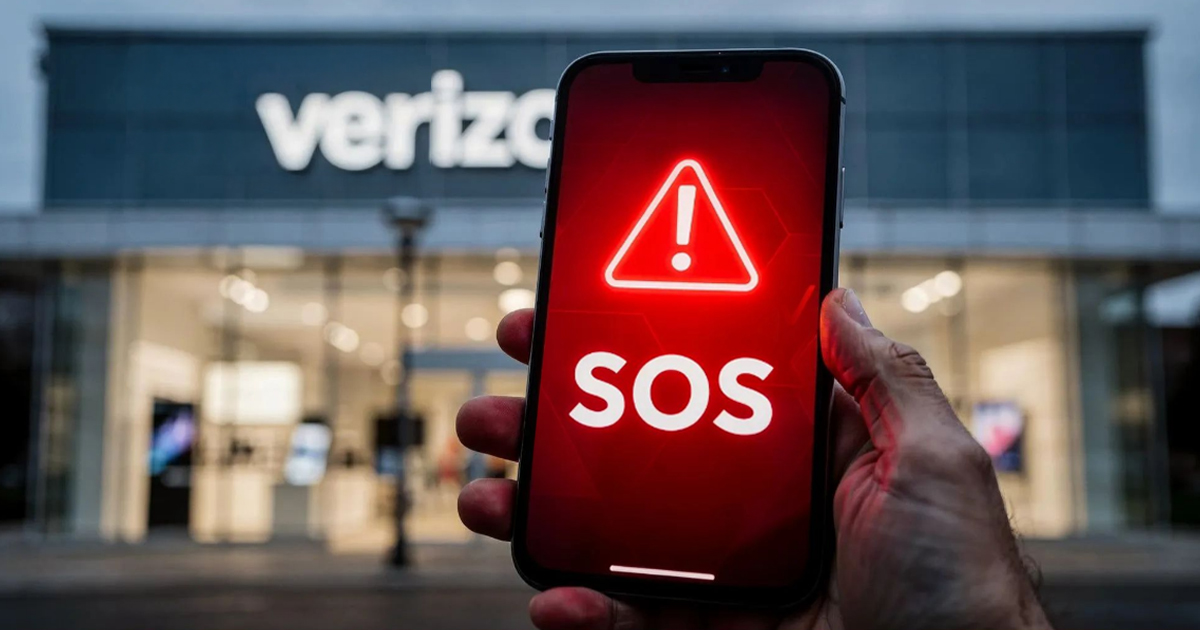
A major nationwide Verizon network outage left iPhone users seeing the “SOS” indicator in their status bars on January 14, 2026. The disruption, which began around midday Eastern Time, prevented thousands of customers from accessing cellular voice and data services, with ripple effects impacting cross-carrier communication across AT&T and T-Mobile networks as well.
What the SOS Indicator Means on Your iPhone
When iPhone users see “SOS” in their status bar, it indicates that the device has lost connection to its cellular network. According to Apple’s support documentation, this status means your iPhone cannot access standard cellular services but can still place emergency calls through any available carrier network. The appearance of this indicator across Verizon’s customer base pointed to a widespread infrastructure issue rather than individual device problems.
The outage reportedly began shortly after 12:00 p.m. Eastern Time, with reports flooding social media and outage tracking services. Users on both the East and West coasts experienced service disruptions, suggesting the problem affected Verizon’s nationwide infrastructure.
Verizon’s Response and Recovery Timeline
Verizon acknowledged the service disruption through its official social media channels, stating that engineering teams were “engaged and working to identify and solve the issue quickly.” The carrier issued multiple updates throughout the day as technical teams worked to restore service.
In an afternoon update, Verizon confirmed that teams were “on the ground actively working to fix today’s service issue,” acknowledging the significant inconvenience to customers. The company stated that restoring connectivity remained its top priority, though no specific timeline for full restoration was provided in initial communications.
Impact on Other Carriers
While Verizon appeared to be the primary carrier experiencing infrastructure problems, AT&T and T-Mobile customers also reported connectivity issues. These secondary effects likely stemmed from cross-network communication failures rather than problems with those carriers’ own infrastructure.
T-Mobile issued a statement clarifying that its network was “operating optimally” but acknowledged that customers may experience difficulty reaching Verizon subscribers due to the ongoing outage. This distinction is important for understanding that the core network failure originated with Verizon’s systems, with other carriers experiencing collateral communication disruptions.
Troubleshooting Steps During Network Outages
During carrier-level outages, individual troubleshooting steps typically provide limited help since the problem exists at the infrastructure level. However, users can take several actions while waiting for service restoration:
- Toggle Airplane Mode on and off to attempt reconnection once service begins restoration
- Connect to Wi-Fi networks for internet access and Wi-Fi calling capabilities
- Avoid repeatedly restarting your device, which can complicate reconnection
- Check carrier social media channels and outage tracking websites for status updates
- Remember that emergency calls remain possible even when SOS is displayed
Historical Context for Major Carrier Outages
Major carrier outages, while disruptive, occur periodically across all major wireless providers. These incidents typically result from software updates, hardware failures, or issues during network maintenance. The nationwide scope of this particular Verizon outage suggests a significant infrastructure component experienced failure, though the specific technical cause was not disclosed in initial carrier statements.
For iPhone users specifically, the SOS indicator serves as an important status signal. Unlike older devices that might simply show no signal bars, the SOS designation clearly communicates both the lack of standard service and the continued ability to reach emergency services.
FAQ
Q: Can I still make emergency calls when my iPhone shows SOS?
A: Yes. The SOS indicator specifically means that while you cannot access your carrier’s standard network, your iPhone can still connect to any available carrier network to place emergency calls to services like 911.
Q: Will restarting my iPhone fix the SOS status during a carrier outage?
A: No. When a carrier-level outage is occurring, restarting your device will not restore service. The problem exists at the network infrastructure level and requires the carrier to resolve the underlying technical issue.
Q: Can I use Wi-Fi calling when my carrier network is down?
A: If you have Wi-Fi calling enabled and access to a Wi-Fi network, you may be able to make and receive calls depending on how the carrier outage affects authentication systems. Results can vary based on the specific nature of the network disruption.
MacReview Verdict
This Verizon outage serves as a reminder of how dependent modern users have become on consistent cellular connectivity. The iPhone’s SOS feature demonstrates Apple’s thoughtful approach to communicating network status, clearly distinguishing between no service and emergency-only capability. While carrier outages remain frustrating and disruptive, particularly for those who rely on cellular connectivity for work or essential communications, the ability to still reach emergency services provides an important safety net. For Verizon customers, this incident highlights the value of having backup connectivity options, whether through Wi-Fi networks or understanding which locations offer alternative communication methods during service disruptions.