Apple’s upcoming MacBook Air with M5 chip is expected to follow the company’s typical spec bump approach, but one critical upgrade remains conspicuously absent from the fanless laptop line. While recent iPad Pro and iPhone models have received significant thermal improvements, the MacBook Air has been left behind with a cooling system that may no longer be adequate for increasingly powerful Apple Silicon chips.
Apple’s Recent Focus on Thermal Management
Over the past two product cycles, Apple has prioritized thermal performance across its most demanding mobile devices. The iPad Pro refresh reportedly incorporated graphite sheets within its main housing and copper material in the Apple logo, resulting in approximately 20% better heat dissipation according to Apple’s claims. This combination allows the thin tablet to sustain performance under demanding workloads without excessive throttling.
The iPhone line received similar attention after overheating complaints emerged with the iPhone 15 Pro. Apple addressed these concerns in two phases: an improved internal design for better heat dissipation in the iPhone 16, followed by a more comprehensive solution in the iPhone 17 Pro. The latest Pro model reportedly features a vapor chamber cooling system paired with an aluminum unibody construction, representing Apple’s most sophisticated thermal design in a smartphone to date.
The MacBook Air Cooling Gap
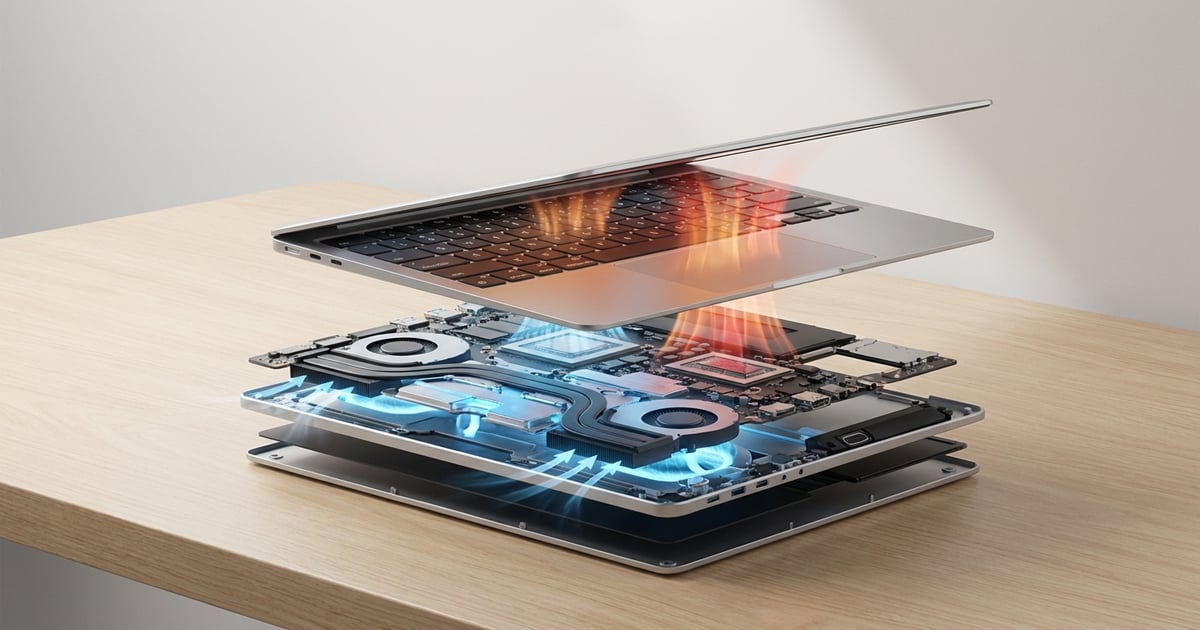
Despite these thermal advances in iPad and iPhone products, the MacBook Air has not received comparable improvements. When Apple redesigned the MacBook Air in 2022, the company transitioned from a larger metal heatsink to a thin graphite sheet without a substantial heat spreader. This design change, while enabling the laptop’s thinner and lighter profile, reportedly resulted in faster thermal throttling compared to the previous MacBook Air generation under sustained workloads.
The current thermal management approach in the MacBook Air consists primarily of passive cooling through the aluminum chassis and minimal graphite material. For chips like the M2, this solution provided adequate cooling for typical usage patterns. However, as Apple Silicon performance continues to increase with each generation, the unchanged thermal system may struggle to keep pace.
Performance Implications
Thermal throttling occurs when a processor reduces its clock speed to prevent overheating. In the MacBook Air’s current design, sustained demanding tasks such as video rendering, software compilation, or intensive multitasking can trigger throttling more quickly than in actively cooled MacBook Pro models. While the M4 and expected M5 chips are more power efficient than their predecessors, their increased performance capabilities also generate more heat under load.
The lack of thermal improvements becomes particularly notable when compared to the iPad Pro, which runs the less demanding iPadOS operating system yet received sophisticated cooling enhancements. The MacBook Air runs full macOS and handles more intensive computing tasks, suggesting it would benefit even more from improved heat management.
Potential Solutions for M5 MacBook Air
Apple has several proven cooling technologies it could incorporate into the MacBook Air without significantly increasing thickness or weight. A vapor chamber system similar to the one reportedly used in the iPhone 17 Pro would provide more efficient heat distribution across the laptop’s internal surface area. Alternatively, Apple could implement the copper heat spreader approach used in the iPad Pro Apple logo, applying it to larger internal components.
Other options include expanded graphite sheets covering more of the internal chassis, improved thermal interface materials between the chip and chassis, or strategic use of additional heat spreading materials in key areas. Any of these solutions would likely improve sustained performance without requiring a fan or major design changes.
Positioning Against the Budget MacBook
Apple is reportedly planning to introduce a new entry-level MacBook model later this year featuring an A18 Pro chip. This budget option will likely compete directly with the base MacBook Air in pricing and positioning. Improved thermal management in the MacBook Air would provide clear differentiation between the two products, giving the Air a performance advantage during sustained workloads that justifies its expected higher price point.
The M5 chip will almost certainly offer more raw performance than the A18 Pro, but without adequate cooling, that advantage may diminish during extended tasks. Better thermals would ensure the MacBook Air can fully utilize its more capable processor across a wider range of use cases.
FAQ
Q: Does thermal throttling affect typical MacBook Air usage?
A: For common tasks like web browsing, document editing, and light photo editing, thermal throttling is unlikely to be noticeable. However, users who perform video editing, software development, or run sustained intensive applications may experience reduced performance compared to actively cooled Mac models.
Q: When is the M5 MacBook Air expected to launch?
A: Apple has not announced a release date for the M5 MacBook Air. Based on historical patterns, new MacBook Air models typically arrive in the spring, though this timeline is not confirmed.
Q: Would better cooling make the MacBook Air thicker or heavier?
A: Not necessarily. Apple has demonstrated with the iPad Pro and iPhone 17 Pro that sophisticated passive cooling systems can be integrated into thin, light devices. Vapor chambers and improved heat spreaders add minimal thickness and weight while providing measurable thermal benefits.
MacReview Verdict
The MacBook Air remains an excellent ultraportable laptop, but its thermal management system has not evolved alongside the increasing capabilities of Apple Silicon. While many MacBook Air users may not push their systems hard enough to encounter throttling, the gap between the Air’s cooling and that of recent iPad Pro and iPhone models is difficult to justify from an engineering perspective.
With the M5 generation expected to arrive soon, Apple has an opportunity to bring the MacBook Air’s thermal design in line with its other premium products. Whether through vapor chamber technology, enhanced heat spreaders, or expanded graphite sheets, improved cooling would ensure the MacBook Air can sustain the performance its chip is capable of delivering. This upgrade would become even more valuable as Apple introduces a lower cost MacBook option, giving the Air clearer differentiation in the product lineup.
For potential buyers, the current M3 and expected M4 MacBook Air models remain compelling choices for most users. However, those who regularly perform sustained intensive tasks may want to consider the actively cooled MacBook Pro line, where thermal performance is prioritized over minimal thickness.