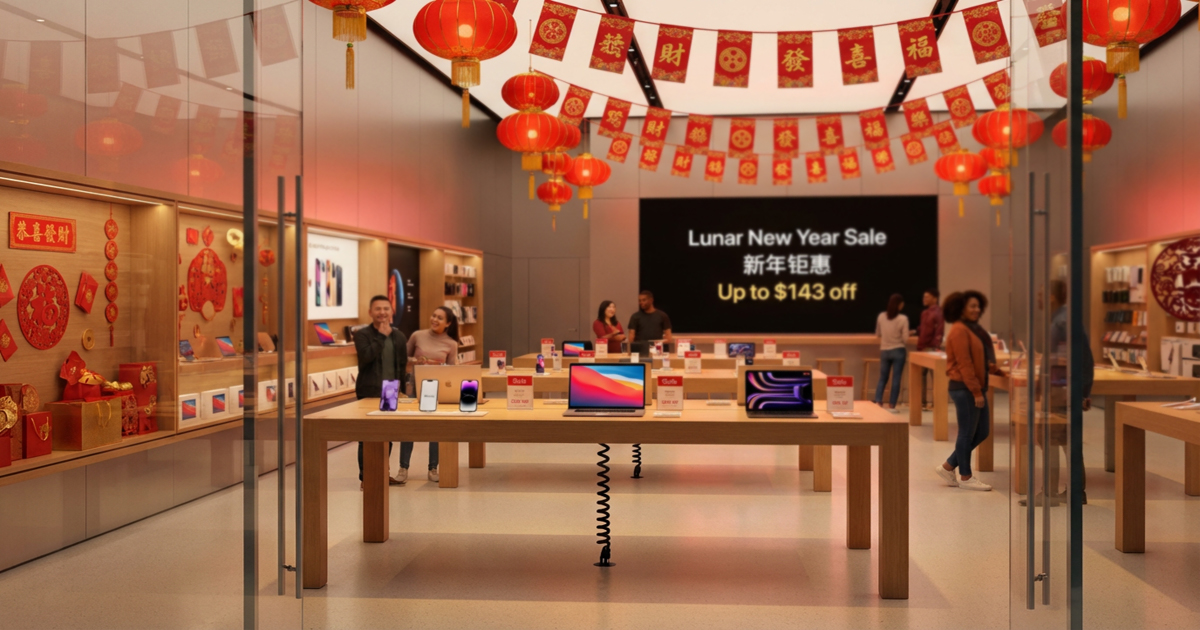
Apple is offering significant discounts on its latest hardware in China during a four-day promotional event tied to the Lunar New Year. The sale, running from January 24 to 27, includes price reductions of up to 1,000 yuan (approximately $143) on eligible products and represents Apple’s continued effort to maintain sales momentum in one of its most important markets.
Eligible Products and Discount Structure
According to Apple’s Chinese website, the promotional pricing applies to a wide range of devices across multiple product categories. The eligible lineup includes recent iPhone models, Mac computers, iPads, Apple Watch variants, AirPods, and the Apple Pencil Pro.
The following devices are reportedly included in the promotion:
- iPhone 16, iPhone 16 Plus, and iPhone 16e
- Mac lineup including MacBook Air M4, MacBook Pro M4/M5, Mac mini, and iMac
- iPad Pro M5, iPad Air M3, iPad A16, and iPad mini A17 Pro
- Apple Watch Ultra 3, Series 11, and SE 3
- AirPods 4, AirPods 4 ANC, and AirPods Max
- Apple Pencil Pro
The discount amounts vary by product and configuration, with the maximum savings reaching 1,000 yuan on select items. It’s worth noting that the recently released iPhone 17 lineup is not included in this promotional campaign.
Terms and Limitations
Apple has implemented several restrictions on the promotional pricing. The discounts apply only when customers use specific payment methods, including Alipay, WeChat Pay, and certain Chinese bank cards. Each customer is limited to two discounted units per product category, and quantities are reportedly limited in retail stores.
The promotion cannot be combined with other discount programs, including Apple’s business, employee, or education pricing. However, customers will be able to trade in eligible devices through Apple’s Trade In program while still receiving the promotional discount, making it possible to stack those savings.
Strategic Timing and Market Context
This limited-time sale comes as Apple has experienced renewed strength in the Chinese market. Recent reports indicate that iPhone shipments in China jumped 28% in the fourth quarter of 2025, driven largely by the iPhone 17 lineup. The Lunar New Year promotion appears designed to extend that momentum across Apple’s broader product range.
The decision to exclude the iPhone 17 from the promotion while including the iPhone 16 models suggests Apple is managing inventory of older devices while maintaining full pricing on its newest flagship smartphones. This approach aligns with Apple’s historical strategy of offering targeted discounts on previous-generation products rather than across-the-board price cuts.
Lunar New Year promotions have become increasingly important for consumer electronics companies in China, as the holiday period traditionally drives significant purchasing activity. Apple’s four-day sale window is strategically timed to capture this seasonal demand.
FAQ
Q: Can customers outside China access these Lunar New Year discounts?
A: No, the promotion is limited to purchases made through Apple’s Chinese website and retail stores, and requires payment methods specific to China including Alipay, WeChat Pay, or select Chinese bank cards.
Q: How many devices can one person purchase at the promotional price?
A: Apple is limiting customers to two discounted units per product category during the promotion. For example, a customer could purchase two discounted iPhones and two discounted iPads, but not three iPhones.
Q: Can the promotional discount be combined with Apple’s education pricing?
A: No, the Lunar New Year promotional pricing cannot be combined with other discount programs including education, business, or employee discounts. The one exception is Apple’s Trade In program, which remains available during the promotion.
MacReview Verdict
Apple’s Lunar New Year promotion reflects a measured approach to maintaining market position in China without resorting to aggressive discounting on its newest products. By offering meaningful savings on the iPhone 16 lineup and other recent hardware while keeping the iPhone 17 at full price, Apple demonstrates its continued ability to segment its product portfolio strategically. The 1,000 yuan maximum discount represents a substantial but not unprecedented price reduction for the region, and the four-day window creates urgency without extending the promotional period long enough to erode perceived value. For Chinese consumers considering purchases in these product categories, the promotion offers genuine savings, particularly when combined with trade-in values. However, the payment method restrictions and quantity limitations suggest Apple is carefully controlling both the scope and cost of the campaign. This approach is consistent with Apple’s broader strategy in China, where the company must balance competitive pricing pressures with its premium brand positioning.